CRANK
payer contract intelligence

Know what you're owed.

This is the 12-minute version of a demo call. Walk it once and you'll know exactly what CRANK does, what it catches, and what it's worth against your own numbers — no meeting required.

  • The operating environment, with primary-source receipts
  • How the engine reads and reconciles your contracts
  • A real walkthrough: six sites, five payers, four fights
  • Your estimated numbers — with the math shown
These three numbers drive the estimate at the end — we do the math in front of you.
No spam, no drip sequence, no patient data — we don't even want yours.
Act 1 · The operating environment

This isn't a story. It's the operating environment.

Every figure below is from a primary source — government investigations, national surveys, CMS data. This is what your revenue cycle is up against now.

1.2 sec

Average time a Cigna medical director spent per claim denial — 300,000 claims rejected in two months.

ProPublica, 2023
2.1×

Growth in UnitedHealthcare's post-acute denial rate in two years — 10.9% to 22.7% — as automation entered claim review.

U.S. Senate Permanent Subcommittee on Investigations, 2024
$25.7B

What providers spent fighting claim denials in a single year — up 23% year over year.

Premier Inc., 2025
70%

Of fought denials were ultimately overturned and paid. The money was owed the whole time — you just had to prove it.

Premier Inc., 2025
11.5%

Of Medicare Advantage denials are ever appealed. Providers win 4 of 5 appeals they file — the rest of that money is simply surrendered.

KFF analysis of CMS data, 2026

They deny at machine speed.
You appeal at human speed.

The only symmetric response is machine-reading your own contracts.

Act 2 · The Gray Zone

Where the money goes to die.

CRANK's founder helped steer a behavioral-health company's contracting analytics through a federal bankruptcy — and saw firsthand how much a provider's survival rides on knowing its contract data cold. On paper, the analytics said the company was owed $X. The bank said $Y — and $Y was a whole lot less.

It wasn't a cliff. It was the Gray Zone: claims held, audited, delayed, doc-requested — every step engineered to break cash flow and bury a small team. Quietly, contract by contract, until the cash ran dry.

In that courtroom, the country's top diligence experts asked the same four questions, every time:

1 · Show me your payer contracts.
2 · Show me exactly what you're supposed to be paid.
3 · Show me what they currently owe you.
4 · Show me your volume.

Four answers that should take four seconds. They took weeks. If you can't answer them, you can't forecast, you can't scale, and eventually you can't survive.

Your payer contracts are your Bible. Period.

CRANK exists because the industry's alternative is an $18,000-a-month consulting agency maintaining a fragile spreadsheet by hand.
Act 3 · What CRANK is

Upload the contract. Get the truth back — with receipts.

CRANK turns the dead PDFs in your contract folder into a living, reconciled layer over your entire revenue cycle. Four steps, no black box.

01 · EXTRACT

Read every contract

Drop in a contract — however ugly the payer's lawyers made it. Specialist extraction pulls every rate, rule, code, and date: 88+ structured data points, human-verified, every value cited back to its page.

02 · RECONCILE

Match paper to payments

CRANK connects to your billing system or EHR — carrying zero patient data — and compares what each contract says you're owed against what actually posted, claim by claim, code by code.

03 · EXPOSE

Every gap, cited

Under-payments, over-payments, downcoding, denial clusters, timely-filing risk — flagged in near real time, each with a dollar figure, a code, a location, and a citation.

04 · NEGOTIATE

Walk in armed

One click builds the strategy brief: rate gaps, dated payer communications, DSO trends, recoverable dollars. You sit across from a billion-dollar payer with the receipts stacked.

Act 4 · The engine

One reconciled layer. Every surface drinks from it.

De-identified claim lines flow in from your EHR. Reconciled truth flows out — to your AI, to every site, to every provider you manage. Hover any node.

ZERO PHI CROSSES THIS LINE only contract IDs · codes · amounts · dates YOUR EHR / BILLING Sunwave · Lightning Step · Kipu de-identified claim lines, daily CRANK PAYER CONTRACT INTELLIGENCE EXTRACT — 88+ points, cited RECONCILE — paper vs. paid EXPOSE — every gap flagged MCP SERVER mcp.runcrank.com read-only · per-user keys Claude ChatGPT any MCP client LOCATION PAGES per-site KPIs & denials free scoped logins Site team sees its site Exec sees the book MULTI-TENANT built for RCM firms isolated by design Provider A Provider B Provider C …
Data in: contract IDs · codes · amounts · dates. Nothing else. Data out: yours. API · MCP · export. Never held hostage.
Act 5 · See it work

See it work — from the seat you sit in.

Three role-based walkthroughs on demo data. The reconciled book for leadership, your site's scoreboard for clinical, the whole machine for operators. No talking heads — just the product doing the work.

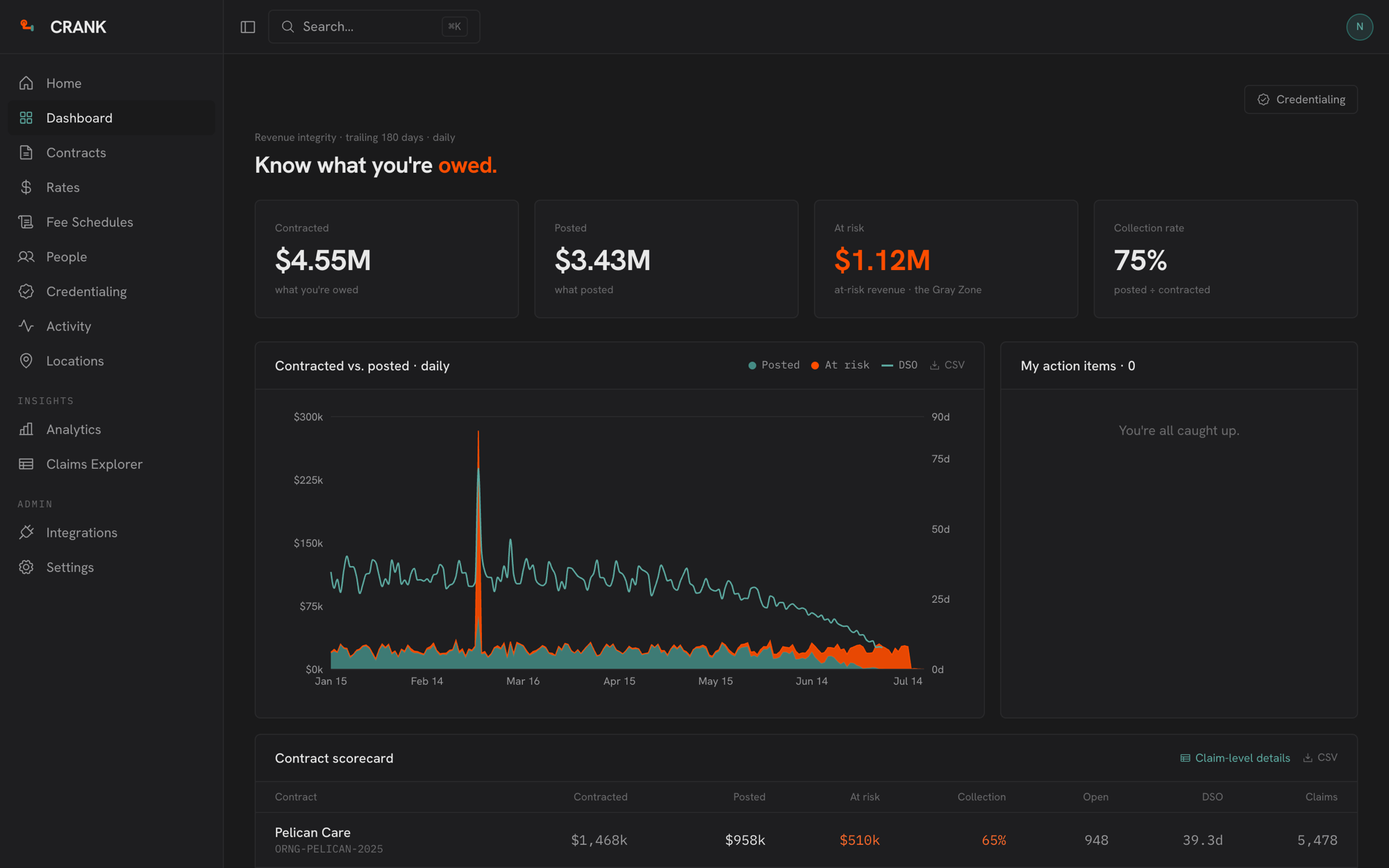
app.runcrank.com/dashboarddemo data
CRANK executive dashboard: contracted vs. posted revenue, at-risk balance, and collection rate
1 min
1 min

Crank for Executives & Owners

For owners, C-suite, and CFOs.

The reconciled book, self-serve — no ticket, no Friday report.

  • Analytics tab — at-risk · trend · payer/site breakdown
  • Yours to run — multi-provider · export · ask-your-AI (MCP)
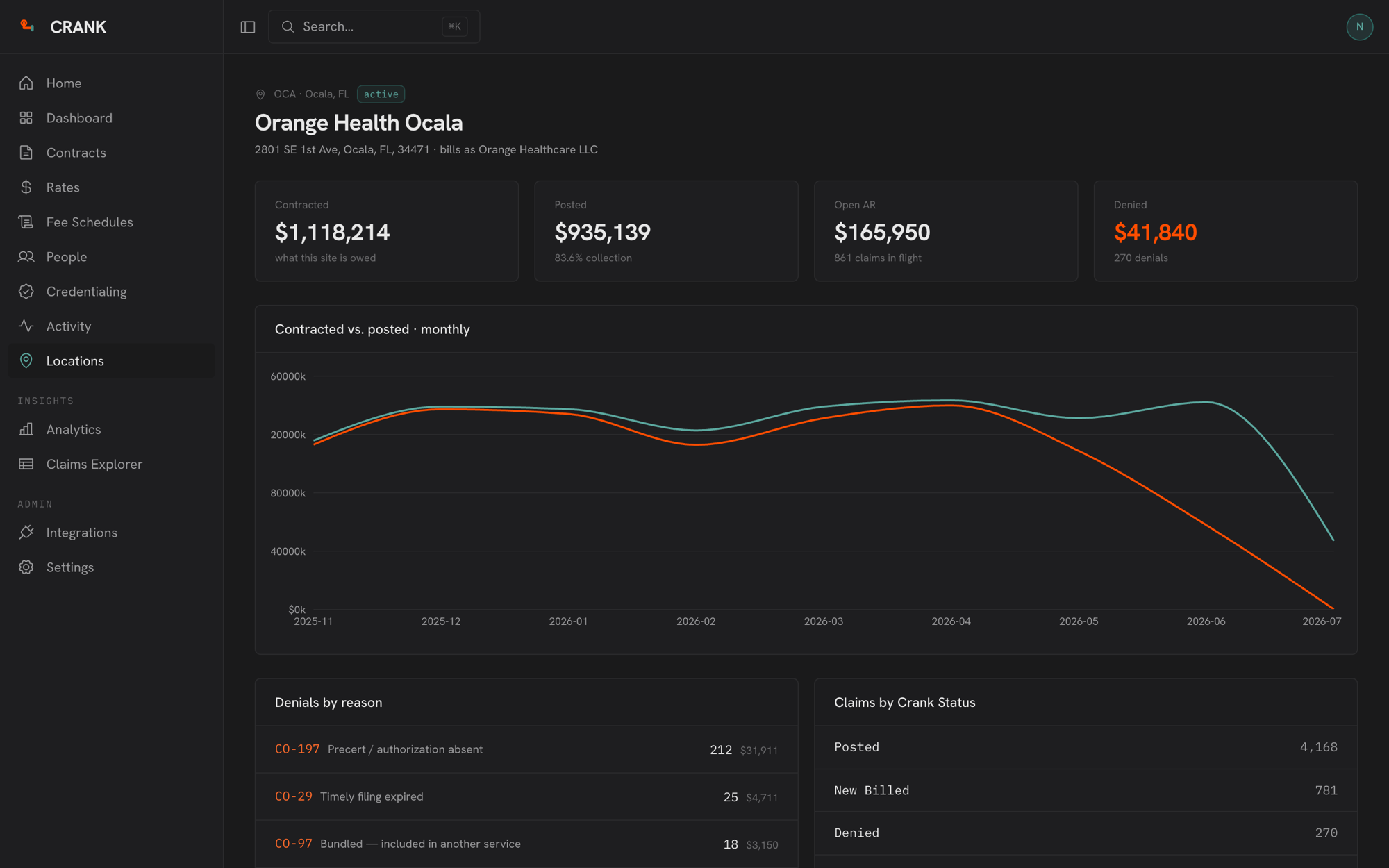
app.runcrank.com/locationsdemo data
CRANK per-site scoreboard: collections, denials by reason, and claims by status for one location
1 min
1 min

Crank for Clinical Leaders

For site directors and clinical / program leadership.

Your site's scoreboard, free — land on your numbers, no analyst.

  • Your scoreboard — collections · denials by reason · claims by status
  • Act on it — see why denied · watch it return to baseline · download a report for leadership
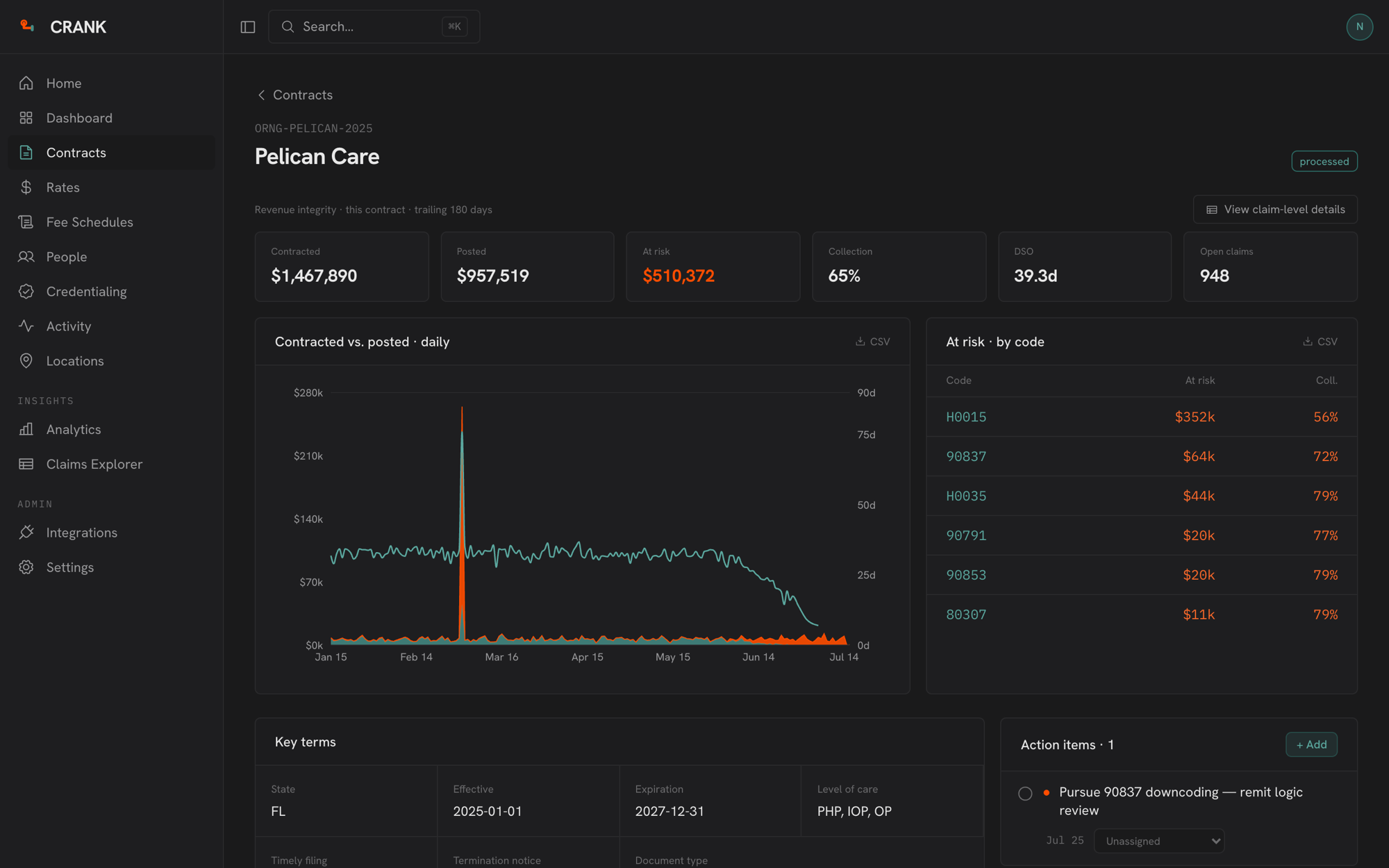
app.runcrank.com/contracts/ORNG-PELICAN-2025demo data
CRANK operator view of one payer contract: contracted vs. posted, at-risk by CPT code, cited terms, and queued action items
deep dive · 3 min
The deep one
Deep dive · 3 min

Crank for RCM Operators

For RCM firms and billing / revenue-cycle operators.

The full operator journey — contract to reconciled to negotiated.

  • One pane, many providers
  • The contract as data, cited
  • The Rates page + MCP
  • Claims + Crank Status — where reconciliation happens
  • Denials by reason & site
  • The bulletproof receipt — the audit trail
  • Walk in armed → Strategy Brief → Know what you're owed.
Act 6 · A real book, walked end to end

Orange Healthcare: six sites, five payers, four fights. demo data

A demonstration provider with realistic, de-identified data — the patterns are the real thing. 24 months of claims, reconciled.

$10.9M
contracted
$9.96M
posted
91.3%
collection
$943K
at risk — and CRANK tells you which part is normal AR and which part is a fight
ORNG-PELICAN-2025 · the won fight

The payer quietly paid 85¢ on the dollar. For months.

January 13: H0015 starts paying $212.50 against a contracted $250.00. No notice, no remark code. Invisible in monthly totals; obvious on a per-code trend.

Flag → dispute → payer admits "configuration error" → $38,437.50 recoupment posted. Fifteen weeks, flag to check — with the audit trail a payer can't argue with.

$250$225$200 DecJanFebMarAprMay contracted $250 flagged
ORNG-EVERGLADE-2024 · denials by location

One new site, one missing workflow, 212 identical denials.

Ocala opened in November without the prior-auth step in intake. By February it was generating CO-197 denials at half its volume — $31.9K, all one reason, all one site. A roll-up hides it; the location view names it.

Team retrained in one session → retro-auths rebilled → $18,257 recovered, denials back to baseline in two weeks. The write-off next door? That one was our side's fault — CRANK says so. Accountability goes both directions.

  • NovOcala opens — auth workflow never makes it into intake
  • FebCO-197 cluster surfaces: 212 denials, $31.9K, one site
  • 3/6Intake team retrained — one session
  • 3/20Denials back to baseline · $18,257 rebilled & recovered
ORNG-SAVRIVER-2025 · the live fight · Georgia

The payer paying too much — the leak nobody watches for.

Amendment 1 cut H0015 from $265 to $240 effective March 1. The remits kept coming at $265 for nine weeks — 72 lines, $2,775 excess. The contract gives the payer 12 months to claw it back.

CRANK flagged it in four weeks: reserved, not booked. When the Q3 recoupment letter lands, it's a non-event instead of a cash surprise. Same codes, different state, different rate card — multi-state without multiple spreadsheets.

  • 3/1Amendment 1 effective: H0015 $265 → $240
  • 3/28CRANK flags: remits still posting at $265
  • 4/28Payer confirms config error — take-back coming
  • Q3Recoupment expected · already reserved. Non-event.
Act 7 · Your numbers

What the Gray Zone costs a book your size.

Estimates from the three numbers you gave us — adjust them freely. Every assumption is shown, because a number without its math is just marketing.

6
25
2,000
$300
Typical behavioral-health claim:
Est. annual billed revenue: $7.2M
$346K
denials alone ≈ 4.8% of revenue (HFMA) — the quiet underpayment layer sits on top
$77K
year-one recovery if you close half the low-end leak (1.5% of revenue)
470 hrs
manual reconciliation & reporting hours returned per year
61 days sooner
payer behavior changes detected (75-day manual lag → 14 days)
1.4×
year-one return vs. CRANK cost (recovery + labor value ÷ $62,500)
$700/contract
× your 25 contracts = $17,500/mo (after any discount) + one-time $8,500 implementation

A one-page business case built from your numbers — the issue, the fix, the outcome, and the investment. Yours to bring to the table.

Show the math — every assumption
AssumptionValueBasis
Average claim valueyour inputpresets from Medicaid BH fee schedules — outpatient ~$150, IOP/PHP ~$400/wk, residential/detox ~$1,300/episode
Annual billed revenueclaims/mo × 12 × avg claimderived, shown above — replace with your real figure on a call
Gray Zone exposure≈ 4.8% of revenuedenials alone, per HFMA; the underpayment layer (step-downs, downcoding, filing traps) sits on top, largely unmeasured
Year-one recovery1.5% of revenuehalf of the low-end leak — payers keep the rest of the benefit of the doubt
Hours returned(contracts × 1.5 + sites × 3) hr/mo × 70%manual per-contract reconciliation + per-site reporting, largely automated
Labor valuehours × $65loaded analyst rate
Detection lag today60 + 0.6 × contracts days (cap 180)per-code drift surfaces at quarterly/annual true-up — if ever
Detection with CRANK14 daysper-code weekly trend (the step-down above was caught in 3 weeks)
CRANK costcontracts × per-contract rate × 12 + $8,500−10% annual pay · −5% multi-year · live per-contract pricing at crankrcm.com

Estimates, for orientation — not a quote and not a promise. Your contracts will tell the real story. That's the point.

The close

Priced to pay for itself. Public, because we mean it.

Every plan is the entire product. Find your contract count:

Up to 10 contracts
$700/contract
Up to 25 contracts
$600/contract
Up to 50 contracts
$500/contract
Up to 100 contracts
$350/contract
Up to 200 contracts
$250/contract
200+ contracts
custom — let's talk

Pay annually and save 10%; commit multi-year and save another 5%. Implementation averages a one-time $8,500, all-in: travel, hands-on training, every contract ingested with you, EHR integrated. You go live, not just licensed.

Bring us your ugliest contract → 20-minute call. We'll read it and show you what it says. No deck — you just watched it.